
Macroeconomic data, the pace of vaccination and global trends would be the major drivers for the domestic equity markets this week, analysts said. Besides, the progress of monsoon will also be monitored. "This week marks the beginning of the new month also, so participants will be eyeing the high-frequency indicators like auto sales and manufacturing PMI during the week. "Besides, the progress of monsoon will also remain on their radar.

From the Sensex pack, State Bank of India, Axis Bank, IndusInd Bank, Tech Mahindra, HCL Technologies, Tata Consultancy Services, Maruti Suzuki, Tata Steel and Tata Motors were the major gainers. Power Grid and HDFC Bank were the laggards from the pack.

Among the Sensex firms, Bajaj Finserv, Tata Motors, Asian Paints, ITC, IndusInd Bank, State Bank of India, Tata Steel, Wipro, Infosys and Maruti were the major gainers. Tech Mahindra, HCL Technologies, Kotak Mahindra Bank, Titan and Larsen & Toubro were the major laggards.

India's manufacturing sector activities moderated in August, as business orders and production rose at softer rates due to the pandemic and rising input costs, a monthly survey said on Wednesday. The seasonally adjusted IHS Markit India Manufacturing Purchasing Managers' Index (PMI) stood at 52.3 in August, down from 55.3 in July, indicating a softer rate of growth that was subdued and below its long-run average. The August PMI data pointed to an improvement in overall operating conditions for the second straight month.

Equity benchmarks snapped their six-session rally to close marginally lower on Thursday amid profit booking in banking and energy counters. Investors also stayed on the sidelines ahead of the RBI's policy meet outcome on Friday. In choppy trade, the 30-share BSE Sensex ended 51.73 points or 0.09 per cent lower at 58,298.80. During the day, it hit a low of 57,577.05 and a high of 58,712.66.

Trading in the domestic stock market would be influenced by trends in the global equities, macroeconomic data and foreign fund movement in a holiday-shortened week, analysts said. Markets may face volatile trends on Monday after Federal Reserve Chair Jerome Powell's speech at the Fed's annual economic symposium in Jackson Hole on Friday.

Slowdown persists in China. India's GDP estimates for 2015-16 are liable to be pared; projections for 2016-17 are lacklustre.

Bolstered by improved domestic demand, India's services sector expanded for the fourth consecutive month in January as business activities quickened and rising business optimism is set to sustain the growth momentum, a monthly survey said on Wednesday. The seasonally-adjusted India Services Business Activity Index rose from 52.3 in December to 52.8 in January, pointing to a quicker expansion in output. The index was above the critical 50 mark that separates growth from contraction for the fourth month in a row during January.

The NSE 50-share Nifty also closed higher by 61.60 points, or 0.59 per cent, at 10,504.80 after shuttling between 10,513 and 10,441.45.
In the absence of major domestic events, equity markets will be driven by global trends, foreign fund flows and movement in the Brent crude oil, analysts said. The major global events this week are the European Central Bank interest rate decision and China's inflation rate, they added. "Indian equity markets are outperforming most of their global peers and trying to show resilience despite weak global cues.

Stock markets are expected to remain under pressure this week due to the overhang of US presidential polls and uncertainty over global growth due to resurging cases of coronavirus, according to analysts.

According to Japanese financial services major Nomura, India's manufacturing PMI remained in the expansion zone but suggested some consolidation after the rapid ramp up of activity in December.

Top losers are Sun Pharma, Bajaj Auto, L&T, ITC, Hero Moto.
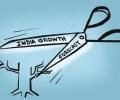
Moody's Investors Service on Thursday slashed India's economic growth projection for 2022 to 7.7 per cent, saying that rising interest rates, uneven monsoon, and slowing global growth will dampen economic momentum on a sequential basis.
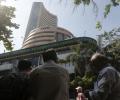
Benchmark indices continued their downtrend on Monday, with the Sensex falling 84.88 points, tracking selling in index majors Infosys and Reliance Industries along with weak global equities. The 30-share BSE benchmark went lower by 84.88 points or 0.15 per cent to settle at 56,975.99 after recovering some lost ground during the fag-end of trade. During the day, it tanked 648.25 points or 1.13 per cent to 56,412.62. The NSE Nifty declined 33.45 points or 0.20 per cent to close at 17,069.10.

India's manufacturing sector activities eased slightly in February but firms were upbeat as they responded to increased new work intakes by stepping up production and purchasing activities, a monthly survey said on Monday. The seasonally-adjusted IHS Markit India Manufacturing Purchasing Managers' Index (PMI) fell marginally to 57.5 in February from 57.7 in January, indicating that even though the pace of growth eased from January it remained sharp in the context of historical data. The headline figure for February remained above its long-run average of 53.6, the survey noted. In PMI parlance, a print above 50 means expansion while a score below 50 denotes contraction.

Foreign portfolio investors (FPIs) turned net buyers in October after being net sellers in the previous month. In October, FPIs bought shares worth nearly Rs 8,430 crore ($1 billion) against net selling of Rs 13,405 crore ($1.6 billion) in September. Positive flows during three of the previous four months have pushed the domestic markets towards fresh all-time highs. At present, the Sensex and Nifty are less than 2 per cent shy of breaching record highs logged in October 2021. A rally in equity markets in the US and Europe is in hopes that the Federal Reserve may go soft on rate hikes after its November meeting.

The Russia-Ukraine conflict, which has spooked financial markets globally, will set the tone for Dalal Street this week amid concerns over energy prices and foreign fund outflows, analysts said. Participants will also track key macroeconomic signals like GDP estimates and PMI data for manufacturing and services sectors to be announced this week, they added. "With earnings season behind us and given the overall sentiments, markets are expected to move in sync with global peers in the coming week. "A close eye will be kept on the developments concerning the Russia - Ukraine crisis and considering the inflation overhang, market participants will also observe movements in energy prices," said Shrikant Chouhan, Head of Equity Research (Retail), Kotak Securities Ltd.

The market breadth in BSE remains positive with 1,554 shares advancing and 1,196 shares declining.

This is the ninth consecutive month that the manufacturing PMI remained above the 50-point-mark.

Out of 30 Sensex shares, 19 ended lower while 11 gained

The NCEAR has indicated some improvement in the fourth quarter of the current financial year.

'Retail investors have been selling since the Budget and Foreign Portfolio Investors started selling.' 'Thus far, domestic institutions have picked up the slack, buying enough to keep the major indices from falling off a cliff.' 'However, there has been carnage in smaller stocks and the financial sector has been hit much harder than the major market indices,' points out Devangshu Datta.

ICICI Bank was the top loser in the Sensex pack, shedding around 2 per cent, followed by Bharti Airtel, Axis Bank, Kotak Bank and PowerGrid. NSE Nifty closed 7.55 points or 0.07 per cent down at 11,527.45.

The S&P BSE Sensex shed 112 points to close at 27,167 and the Nifty50 dropped 35 points to finish at 8,336.

Foreign portfolio investors (FPIs) were net buyers to the tune of Rs 16,459 crore in Indian markets in August, with majority of investment coming in the debt segment. In equities, they invested just Rs 2,082.94 crore while debt segment saw inflow of Rs 14,376.2 crore between August 2-31, depositories data showed. The quantum of investment in the debt segment is highest in this calender year so far.

India's inflation trajectory in the coming months will be influenced more by the geo-political situation due to the war in Europe and its impact on supply chains and commodity prices. However, the country is better placed than most to "weather the storm" and achieve growth of close to 8 per cent in the current fiscal year, the finance ministry said in its latest monthly economic report on Thursday. "Through the channel of imports, elevated global crude and edible oil prices now have a significant impact on India's inflation outlook. "Government measures to keep the prices of these commodities in check, along with the recent hike in policy rates by the RBI, are expected to temper inflationary pressures in the economy," the monthly economic report for April, drafted by the finance ministry's economic division, said.
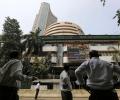
On the macroeconomic data front, PMI data on manufacturing and services sector will also influence trading

The breadth, indicating strength of the market was strong

India is facing no risk of recession or stagflation as macroeconomic fundamentals of the economy are strong, Finance Minister Nirmala Sitharaman said on Monday. Replying to a debate on price rise in the Lok Sabha, she said the GST collection and Purchasing Managers' Index (PMI) are indicating that the Indian economy is getting more robust. The GST collection rose 28 per cent to touch the second-highest level of Rs 1.49 lakh crore in July. GST, introduced in July 2017, touched a record high of Rs 1.68 lakh crore in April 2022.

RBI's fifth bi-monthly monetary policy meet due tomorrow also kept the investors on their toes.

Indian economy is expected to grow 10.5 per cent or more in the current fiscal, Niti Aayog Vice Chairman Rajiv Kumar said on Thursday. Speaking at a virtual conference organised by the Public Affairs Forum of India (PAFI), he also said that modernisation of the retail sector is very much on the cards. "India Purchasing Managers' Index (PMI) for both manufacturing and services has shown a very smart uptick last month. "This (Indian economy) will strengthen even further," he said. "I expect Indian economy to grow 10.5 per cent or higher in FY 22," he noted.

Bajaj Auto was the top gainer in the Sensex pack, surging 3.95 per cent followed by Maruti Suzuki at 2.69 per cent.

Share markets will have only three trading days this week with Monday and Wednesday being holidays due to general elections in Mumbai and Maharashtra Day, respectively.

The Nikkei India Manufacturing Purchasing Managers' Index (PMI) stood at 47.9 in July, down from 50.9 in June, its lowest mark since February 2009, and highlighted the first deterioration in business conditions in 2017 so far.

'The real lifting of the economy will happen only if this momentum sustains in the coming months.'
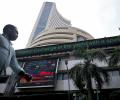
RBI policy, macro data, company earnings to decide market course this week: Experts

Expenditure cuts necessitated by slowing revenue growth, weak industrial activity worrisome portents

Experts said the slowdown could be attributed to adjustments leading to destocking and the offering of discounts by companies as the government ushered in the new indirect taxation system on July 1.

Private sector output in India expanded for the first time in 8 months in February as slump in the services sector moderated and manufacturing grew at a stronger pace, an HSBC survey said.
